A Multilingual Website for a Children's Centre
Three languages, a catalogue of clubs and a schedule that has to be updated every season. Here is what being multilingual really means for the amount of work, and how it is handled technically.
Updated
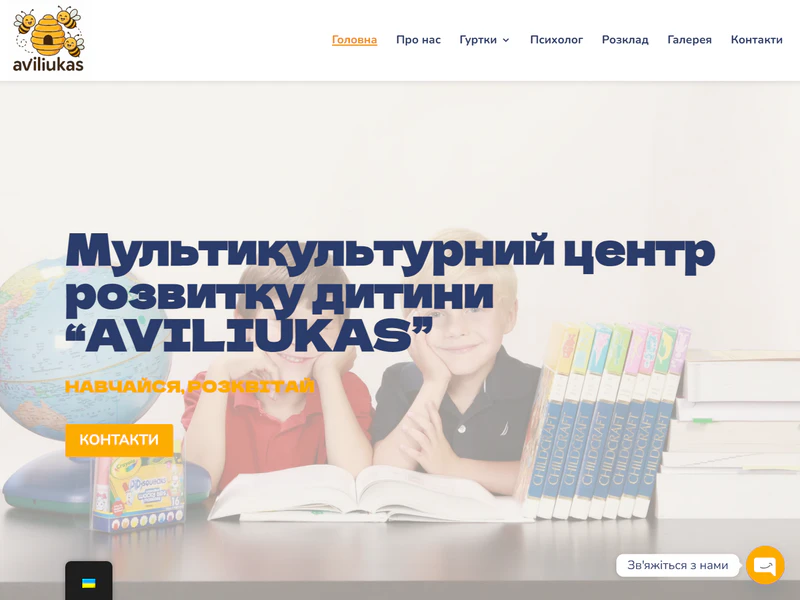
aviliukas.eu
WordPress • Divi • Multilingual
What mattered most here
A multilingual site is not a single-language site with a translate button.
Every language has its own URL
A translation that changes in the browser without changing the address does not exist as far as search engines are concerned. Each language version has its own URL that can be found, opened and forwarded.
The languages are linked to each other
The relationship between languages is declared separately, so a search engine understands that this is the same page in another language rather than three separate sites with similar content.
The content multiplies
Every new club is not one text but three. That is the most important planning question on a multilingual site, and the most commonly underestimated one.
What this site is
Aviliukas is a multicultural education centre for children and teenagers in Kaunas, at Kęstučio g. 43. The centre runs clubs: English and Lithuanian language, graphics, music, dance, knitting, developmental activities and sessions with a psychologist.
The site has a catalogue of clubs, a schedule, a gallery, information about the centre, contacts and a contact form. The content is presented in three languages — Ukrainian, Lithuanian and English. Technically it is WordPress with the Divi editor.
Why three languages here
The audience genuinely is trilingual. The centre is attended by children from Ukrainian families living in Lithuania, by local families, and by English-speaking foreigners. These are not languages added just in case — each version has its own reader, and parents look for information in the language they speak at home.
That is precisely the condition under which a multilingual site makes sense. If languages are added because it looks more solid, they only increase the maintenance burden without bringing visitors.
What being multilingual means technically
The address matters more than the button
The main mistake is a translation that changes the text in the browser but not the address of the page. Such a version does not exist for a search engine: it cannot be found and it cannot be sent as a link. So each language here has its own URL, and every one of them can be opened directly.
The languages have to be linked
When the same page exists in three languages, a search engine has to be told that this is one and the same information in different languages rather than three similar sites. Dedicated links between the versions do that. Without them the language versions compete with each other — there is more on this on the multilingual websites page.
The switcher has to lead to the same page
A language switcher that sends you back to the home page from wherever you were is the most common small defect on multilingual sites. Switching language from a club description should leave you on that same club description.
What usually gets overlooked
The amount of content. Every new club, every schedule change and every news item is not one text but three. The technical part is done once; the content work repeats for the whole life of the site.
So before starting I always ask the same thing: who will prepare the translations, and will all the languages really be kept up. The more honest answer is often two complete languages rather than three half-filled ones. I do not provide translations — the client prepares them, because it is the language of their field.
Who the same solution fits
A multilingual site is worth the work when each language has a real audience and there is someone to keep the content up. WordPress was chosen here for the same reason as on Dalyvus.lt — the organisation works with the site itself.
FAQ
What people ask when a site needs several languages.
Can we just add a Google translate button?
You can, but it does nothing for search: automatic translation does not change the page address, so as far as a search engine is concerned that version does not exist. If the language is there for a market rather than for convenience, each version needs its own URL.
Who prepares the translations?
The client does — it is their field and their terminology. I handle the technical side: the URLs, the links between languages, the switcher, and making sure every version is complete.
What does a multilingual site cost?
The technical multilingual setup is part of the business scope, from €200. But the main cost is not technical: every page has to be prepared as many times as there are languages.
Can a language be added later?
It can, and that is normal. The only thing that matters is choosing a solution from the start that does not cap the number of languages — then a third language is content work rather than a rebuild.
What is next
- Multilingual websitesThe same topic as a service: URLs, hreflang, who prepares what.
- Dalyvus.lt — an association websiteAnother project where filling in the content independently was the main condition.
- Šviesi galva — a school websiteA project where the content was structured, and the stack followed from that.
Need a site in several languages?
Write which languages you need and who will prepare the translations — I will tell you what has to be done technically and what the content will realistically cost.
Get in touch